
Abstract
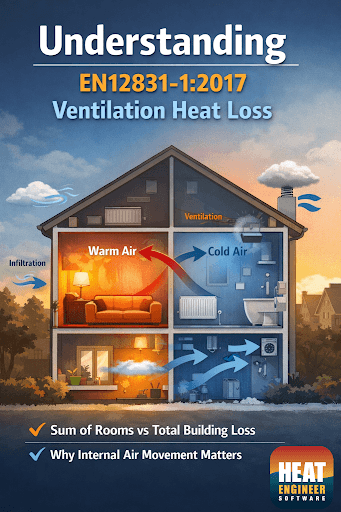
This document explains a commonly misunderstood outcome of BS EN 12831-1:2017: why the sum of individual room heat losses is greater than the total building (or zone) heat loss, particularly for ventilation and infiltration.
EN 12831-1 includes a fi-z factor specifically for wind-driven ventilation/infiltration part of sizing heating. The fi-z factor can have a value of '1' where 100% of the wind driven ventilation/infiltration is included, or '0.5' where just 50% of this is included.
For sizing a room heat emitter, the worst case is when the room is facing windward and all this ventilation/infiltration heat loss should be allowed for (fi-z = 1). However, for the central plant sizing worst case it only sees about half of rooms with its worst case, while the other half are on the leeward without this ventilation/infiltration heat loss. Consequently for sizing the central plant capacity a halving of the wind driven ventilation/infiltration heat loss component is typically used (fi-z = 0.5).
Summary
The key reason is that EN 12831 sizes rooms and the building heat source for different design purposes.
At room level, the standard deliberately applies worst-case assumptions. Each room heat emitter must be capable of covering:
- Heat lost directly to outside via infiltration and ventilation, and
- Heat carried out of the room by air moving to adjacent spaces.
For this reason, no reduction factor is applied to room ventilation heat losses (Equation 17). This ensures that emitters are robustly sized for unfavourable wind, pressure, and airflow conditions on the design day.
At zone or building level, EN 12831 only counts heat that actually leaves the building envelope. Air that moves between rooms remains within the heated zone and does not represent a net loss of heat to outside. To avoid double-counting internally retained heat, the standard applies the zone ventilation reduction factor fᵢ,z = 0.5 (Equation 16).
This approach applies regardless of heating control strategy:
- Zoned systems with TRVs, and
- Open-zone dwellings with a single thermostat
are treated identically. EN 12831 is control-agnostic because it is a design-day sizing standard, not an operational or energy-use model.
A central misconception addressed in this document is the belief that equal room temperatures imply no internal air movement. In reality, airflow is driven by pressure differences, not temperature differences. Even in open-zone homes with uniform setpoints, internal air movement persists due to:
- Windward and leeward façade pressure differences,
- Extract ventilation in kitchens and bathrooms,
- Stack effect through stairwells and vertical spaces,
- Uneven leakage paths and door positions.
As a result, internal air continues to redistribute heat between rooms, even when temperatures are equal. This redistribution increases individual room heat loss calculations but does not increase the net building heat loss.
Key conclusion: Under EN 12831-1:2017, it is correct and intentional that:
The sum of room ventilation heat losses exceeds the total zone or building ventilation heat loss.
Introduction
This article helps explain to heating engineers (boilers and heat pumps) why the sum of room heat losses differs from the total zone/building heat loss in EN 12831-1:2017.
The total sum of all rooms heat loss will be bigger than the zone/building heat loss.
Many heating engineers are still very confused why this is the case. This is mainly because the zone/building calculation applies the zone ventilation reduction factor fᵢ,z = 0.5 in Equation (16) (highlighted below).
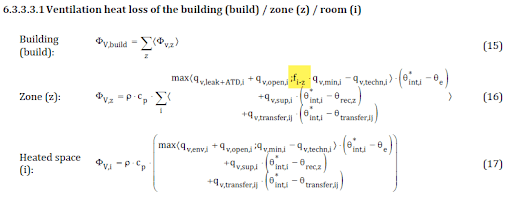
The justification for not including this fi-z factor of 0.5 in equation 17 for determining each room ventilation heat loss is to allow for windward/leeward impacts and the loss of heated air moving to adjacent/parallel rooms.
Therefore, the internal movement of warm air from one room to another does not need to be factored in when sizing the heat source from the total zone/building heat loss. EN 12831 applies fi-z = 0.5 to represent the fact that, at zone/building level, a portion of air exchange is retained within the ventilation zone (e.g., windward/leeward effects and inter-room transfer), and should not be counted as net loss to outside.
Why does the sum of room heat losses exceed the building heat loss?
EN 12831 sizes rooms and the building heat source for different purposes.
Room heat losses are calculated for worst-case local conditions. Each room emitter must be able to cover:
- External ventilation and infiltration, and
- Internal air leaving the room to adjacent spaces.
For this reason, no reduction factor is applied at room level (Equation 17).
Building (zone) heat loss is calculated only for heat that actually leaves the building envelope. Air moving between rooms stays inside the heated zone and does not represent a net heat loss.
To avoid double-counting this internally retained heat, EN 12831 applies the zone ventilation reduction factor:
fᵢ,z = 0.5 (Equation 16)
This applies:
- Whether rooms are controlled individually with TRVs (Figure 3), or
- Whether the dwelling operates as a single open zone with one thermostat (Figure 5).
Control strategy does not change the calculation logic. EN 12831 is a design-day sizing standard, not an operational model.
Key rule: The sum of room ventilation heat losses will always be greater than the total zone/building ventilation heat loss — by design.
Illustrating a building with Zone control with TRV’s
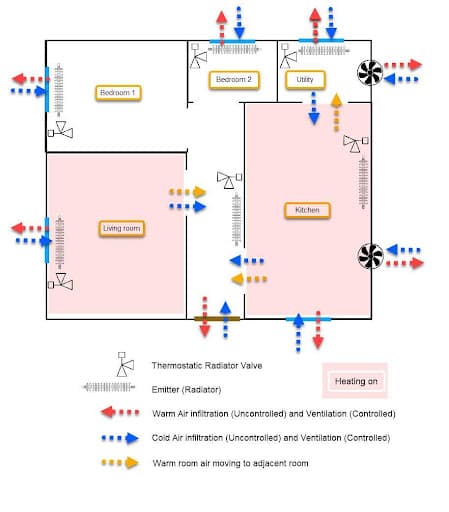
An incorrect representation
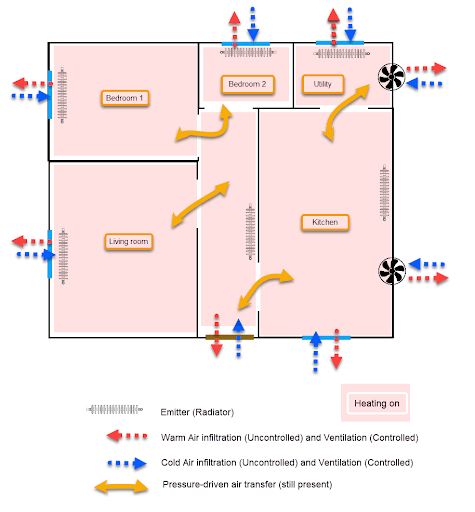
This diagram figure 4, is assuming there is no Pressure driven internal air movements even with equal temperature. This is NOT the case. Figure 4 shows a common incorrect assumption. Figure 5 shows the corrected representation.
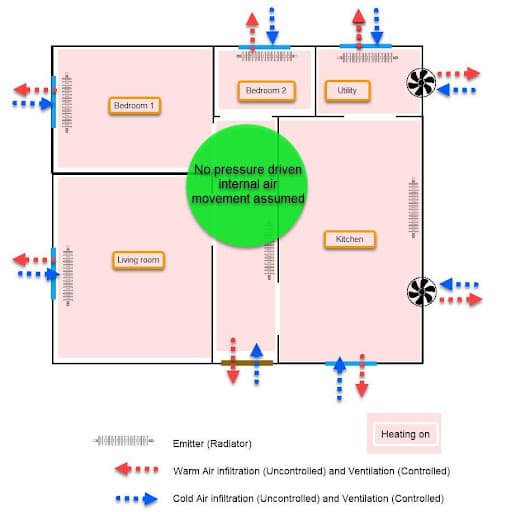
Pressure-driven internal air movement (even with equal temperatures)
Even with:
- one thermostat
- no TRVs
- uniform setpoint
There are still pressure differences caused by:
- extract fans (bathroom / kitchen)
- windward vs leeward façades
- stack effect via stairwells
- door positions
- leakage distribution
Internal air movement does not disappear just because temperatures equalise.
In almost every dwelling:
- Air is extracted from bathrooms / kitchens
- Replacement air comes from other rooms
- Even in an open zone.
Internal air movement does not disappear just because temperatures equalise.
Equal room temperatures do not imply zero internal air movement or zero internal heat transfer on the design day.
Illustration of an open zone system with no TRV’s.
Equal room temperatures do not imply zero internal air movement or zero internal heat transfer on the design day.
Still confused? Why your intuition says this, but physics says that.
What intuition tells us
It feels logical to assume that:
- If all rooms are heated together
- If all rooms are at the same temperature
- If there are no TRVs and only one thermostat
- then there should be no air movement between rooms, and therefore
- the sum of room heat losses should equal the total building heat loss.
This intuition comes from thinking about temperature only.
What physics actually says
Air does not move because of temperature alone.
Air moves because of pressure differences.
Even in an open-zone dwelling with uniform temperatures, pressure differences still exist due to:
- Wind acting on different façades (windward vs leeward)
- Extract ventilation in kitchens and bathrooms
- Stack effect via stairwells and vertical spaces
- Uneven leakage paths in the building envelope
- Doors being open or partially closed
As a result:
- Air continues to move between rooms
- Warm air leaves some rooms and enters others
- Heat is redistributed internally even when temperatures are equal
The critical distinction
Internal air movement:
- Does move heat between rooms
- Does not remove heat from the building
Heat loss only occurs when air crosses the external envelope.
This is why EN 12831:
- Sizes rooms conservatively (each room must cover its own worst-case losses)
- Reduces building-level ventilation heat loss using the fᵢ,z factor, to avoid double-counting internally retained heat
Why controls don’t change this
Heating controls (TRVs, single thermostat, zoning) affect when and how often rooms are heated.
They do not eliminate:
- Wind pressure
- Ventilation-induced airflow
- Stack-driven air movement
EN 12831 is therefore intentionally control-agnostic:
It sizes for the worst-case physical conditions, not typical operation.
For more technical articles visit the blog